Downtown Sioux Falls Over 50 Years
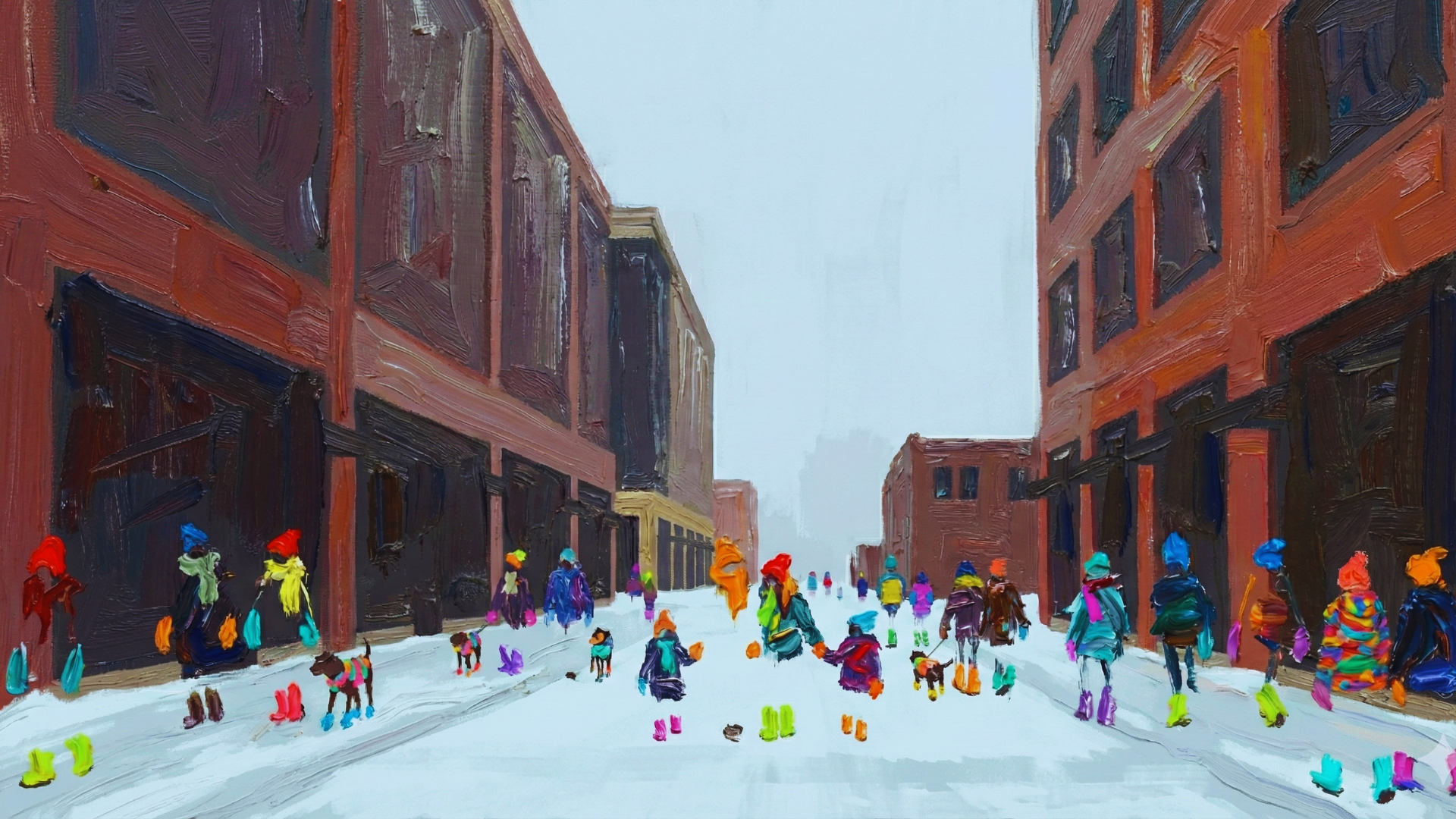
It's fifty degrees a few days before Christmas. That's not normal. But normal left the building about a decade ago, and Sioux Falls didn't get the memo to panic.
I run a business here. I chose this city when I could've chosen anywhere. I've watched the cranes multiply, watched the coffee shops replace the vacancies, watched people bet on this place when the safe money said don't. So when I tell you what I see, understand: my rent check depends on whether I'm right.
Seven thousand gallons per second still pour over the Falls—same rhythm it had before anyone platted a grid around it, same rhythm it'll have a hundred years from now. And still, people come. All walks of life, drawn to the one place in a city bursting at the seams where you can stand next to something older than ambition.
The Lakota knew this place before anyone put a price on it. The Dakota held it sacred before a single zoning permit existed. That history doesn't show up in the economic development presentations. But it's underneath every square foot of downtown.
And then the wind shifts and Smithfield announces itself. Pungent. Metallic. Unavoidable.
You know what that smell is? That's a city that didn't get embarrassed about where the money came from. That's work. Most cities would've pushed that plant to the county line by now, sanitized the whole narrative. Sioux Falls kept it. Right there. Reminding everyone that before the remote workers discovered your cost of living, somebody was showing up at 5 AM to do work that didn't require a laptop.
Let me walk you through this, because the texture matters.
Start on Philips. The State Theatre marquee glows—promising something it hasn't quite delivered yet. It's been our own little Broadway in the civic imagination for decades. Every few years, someone announces the revival. The rendering looks beautiful. The timeline slips. And still, people show up to the next meeting.
Past Fernson, where the taproom hums with a mix of people who remember when this block was something else entirely and people who just moved here for the quality of life. They're drinking the same beer. Nobody's asking for credentials.
Then Zandbroz. If you haven't been in there, you're missing one of the most underrated retail experiences in the Midwest. Old tins. Candles that smell like someone's grandmother's kitchen. Books arranged like they're waiting for a specific person to find them.
Coffea next. The line moves. The espresso is serious. A guy in a Carhartt jacket talks to someone who just closed a Series A. Nobody performs it. They just coexist.
Cross the tracks. The energy shifts.
Queen City Bakery. Almond pastry and a cortado—that's the order. Say hello to Mitch, the owner, who's become proof that doing things boldly your way can actually work in a city that doesn't always adopt new ideas on the first pass. Tech founders in Patagonia vests stand in line next to retired teachers who've been coming since day one. Mitch made space for that. He's a pillar now.
And then you feel it—the buzz. Pomegranate Market opened its second location last week. Specialty goods, curated shelves, a new anchor in the middle of blocks that still remember what they used to be. There's a tension there—not hostile, just present. Whether that's progress or erasure depends on how long your family's been here.
The development politics happen in the buildings, not on the feeds.
This is South Dakota. People don't fight on Twitter here. They show up to city council meetings, say something vague but pointed, and then go build what they were going to build anyway. Passion and self-interest move through zoning applications and handshake deals at Rotary lunches. Conflict avoidance runs deep—five generations of Lutheran restraint will do that.
Here's the thing nobody wants to say out loud: that same restraint is also why it took 15 years to figure out the State Theatre. Why the city council can't have an honest conversation about density. Why landlords raise rents 40% and everyone just... absorbs it. The politeness that keeps people civil also keeps them from saying the thing that needs to be said until the damage is already done.
Sioux Falls moves forward—but sometimes it moves forward the way a glacier does. Slowly. Silently. Grinding over whoever couldn't get out of the way in time.
And above it all—literally—something else has been watching.
The Penitentiary sits high on the hill. Same Sioux quartzite as the Falls below. Same sightline it's had for over a century. It sees the cranes. It sees the coffee shops. It sees who comes and who goes.
For some, it's a moral compass—a reminder, quiet but permanent, that actions have weight. For others, it's a mini Alcatraz with mystique and fearful curiosity, the kind of place you point to from the observation tower and wonder what stories those walls hold. And for others still—those with loved ones inside—it's something else entirely. A place to connect. A parking lot visit. A phone call. A thread that doesn't break just because someone made a mistake.
The prison doesn't care about the renderings. It just watches.
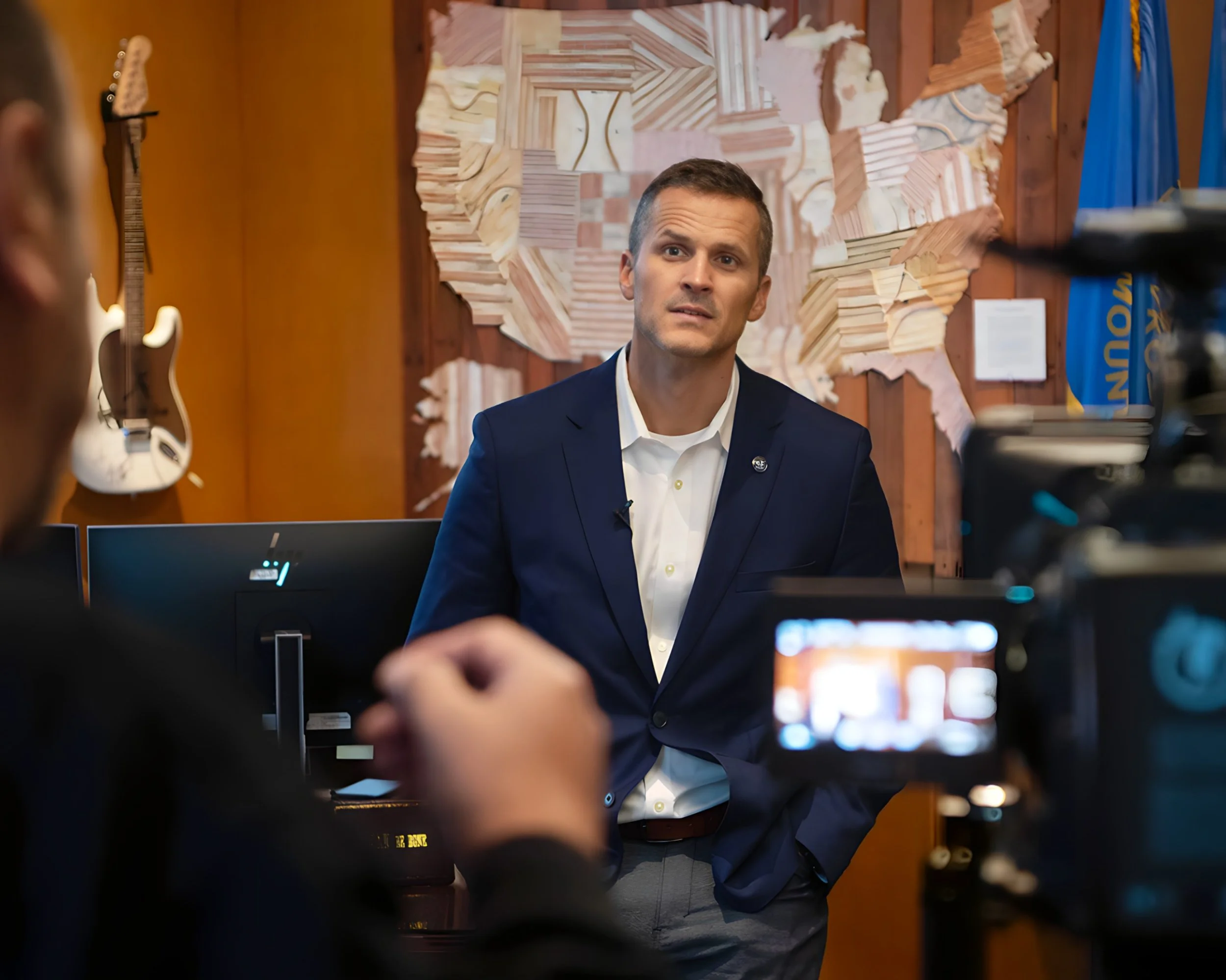
Paul TenHaken
Built Click Rain before he ever ran for anything. Won the mayor's seat in 2018, then got hit with a tornado, historic flooding, COVID at Smithfield, and George Floyd—back to back. The people who showed up ready to oppose him came around quietly. He's leaving in 2026. The void he leaves? That's the question now.
Paul TenHaken. The mayor. The guy a lot of people didn't want to like—and then quietly ended up liking anyway.
Founded Click Rain before he ever ran for anything. Then in 2018, he ran for mayor. Won. And then the chaos started: a tornado that ripped through the busiest streets in town, flooding that swamped neighborhoods, COVID exploding through Smithfield, racial tensions after George Floyd. Back to back to back.
He didn't break.
The people who showed up ready to oppose him came around. Quietly. No public endorsements. Just less resistance at the next council meeting. A nod in the coffee shop. That's how it works here.
He's been the connective tissue between the developers and the artists, the old guard and the new money. He held the tension without pretending it didn't exist.
Now he's leaving. Term ends in 2026. Stepping back for family. The job description he leaves behind: balance humanity with property taxes, hold space for the arts while the zoning fights get uglier, keep the contradictions in frame.
TenHaken threaded that needle for eight years. The next person has to learn it from scratch—and they'll be doing it while the money gets louder.
Keep walking. 8th Street. The East Bank. Sanaa's.

Sanaa Abourezk
Syrian-born. Trained as an engineer. Married to Jim Abourezk—the first Arab-American U.S. Senator. Opened a Mediterranean restaurant in 2003 when everyone said she was crazy. The New York Times called her the trailblazer of Sioux Falls' culinary scene. She's not running a restaurant—she's running a thesis statement.
Sanaa Abourezk is the story nobody outside this city knows but everyone inside it does.
Syrian-born. Trained as an engineer. Married to Jim Abourezk—the first Arab-American to serve in the U.S. Senate. Moved to South Dakota and opened a Mediterranean restaurant in 2003, in a state where the food groups were beef, potatoes, and ranch dressing.
People told her she was crazy. No burgers? No fries? In South Dakota?
She did it anyway. The New York Times called her the trailblazer of Sioux Falls' culinary scene. James Beard semifinalist in 2023 and 2024. She bet on quality in a place people underestimated.
They showed up. Sanaa's isn't a business. It's a landmark.
And then there's MarketBeat. Same neighborhood. Different story. Same point.
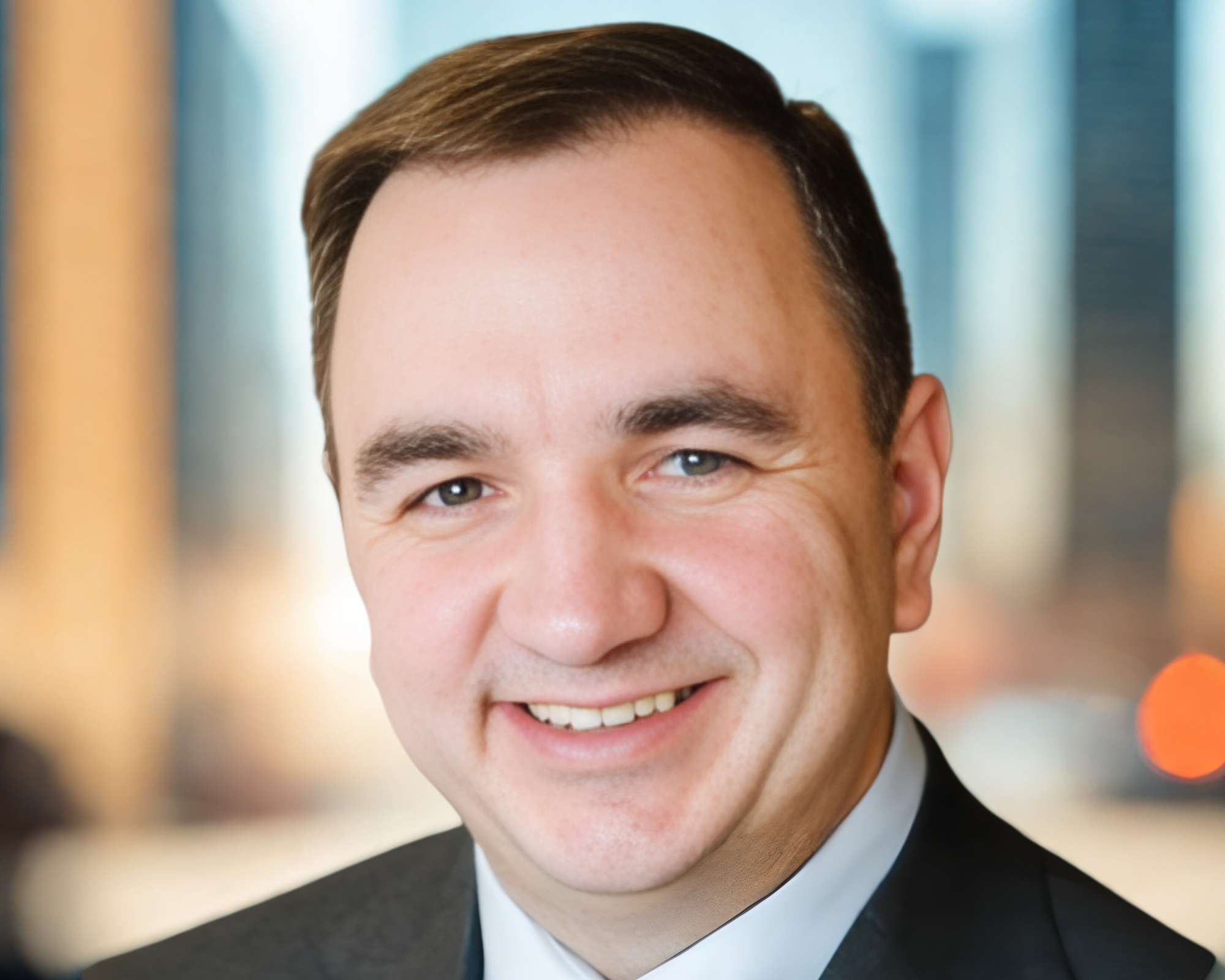
Matt Paulson
Started a stock newsletter in college. Kept building. Now it's the largest digital media company in South Dakota—$40M revenue, 20M monthly visits, 5.5M subscribers. Eighteen employees. Downtown Sioux Falls. He's not extracting—he's reinvesting. Building the city he wants to live in.
Matt Paulson started it in college. Needed income. Built a stock market newsletter. Kept building. Now it's the largest digital media company in South Dakota. $40 million in revenue. 20 million monthly visits. Inc. 5000 list eight years running. Eighteen employees. Downtown Sioux Falls.
This isn't a satellite office for a coastal company. This is a global financial media platform built from scratch in a city of 200,000, competing with New York and San Francisco and winning.
Paulson sponsors half the city—the holiday plaza, the tennis tournament, the Levitt concerts, Startup Sioux Falls. He's doing it because this is his city and he wants it to be better. That's the unlock. The entrepreneurs here aren't just extracting—they're reinvesting.
The question is whether the next generation does the same. Or whether they take the exit and move to Scottsdale.
A Syrian immigrant who bet on hummus in beef country, a kid who built a financial media empire from his dorm room, and a reluctant politician who held the city together through one crisis after another. All downtown. All intermingled.
That's not an accident. That's a city that figured something out.
Here's the tension nobody wants to name: the Union Gospel Mission sits on the same streets where new money walks past. That's not a bug. That's the feature. You can see both realities from the same corner.
Most cities push that out. Zone it away. Pretend the contradictions don't exist. Sioux Falls kept them in frame.
But keeping contradictions in frame is not the same as resolving them.
Will this city actually make it?
I don't mean survive. Sioux Falls will survive. The question is whether it becomes another Boise—a place that got discovered, got expensive, and lost the thing that made people fall in love with it in the first place.
Here's what could break it: Median home prices up 47% since 2020. Apartment rents that doubled in some buildings. The young teachers and nurses and line cooks who made this city functional? They're doing the math. Some of them are already gone. The founders who built here are watching their equity climb—and at some point, the spreadsheet says sell and leave. The passive-aggressive culture that keeps things civil also keeps anyone from standing up at a city council meeting and saying: we are pricing out the people who actually run this city.
That's the threat. Not crime. Not politics. Complacency dressed up as prosperity.
What was: a city that smelled like labor and didn't feel the need to explain itself.
What is: a city learning how to be watched without losing its edge.
Here's my bet—and it's a real bet, because my business lives or dies on whether this city keeps working: Sioux Falls has a shot. Not to be Austin. Not to be the next anything. To be the thing it's been building toward for decades while nobody outside the 605 was paying attention.
The Dutch Lutherans planted the roots—churches and corn, five generations of showing up without talking about it. The steak-and-potato farmers built the work ethic. And now the founders and the artists and the immigrants and the risk-takers are grafting something new onto that trunk.
It shouldn't work. The conflict avoidance alone should slow it down. The passive-aggressive city council meetings. The deals made over beers and not in boardrooms. The way nobody says what they mean until the building's already half-built.
But it's working. For now.
The Falls keep running—seven thousand gallons per second, same as yesterday, same as a century from now. The Penitentiary keeps watching from the hill.
On a fifty-degree afternoon in December, you can feel it in real time.
Not finished.
Not settled.
But real.
Steel doesn't apologize.
Neither should a city that still smells like work. That keeps the Mission and the Market on the same map. That gave Sanaa a shot when the safe bet was burgers. That let a kid with a newsletter become a media mogul without ever leaving downtown. That handed a reluctant politician the keys and watched him grow into the job.
A city standing on ground that was sacred before it was zoned—building through the tension, one passive-aggressive handshake at a time.
Whether it holds is up to the people who stay. And whether the people who stay can finally say the thing that needs to be said—before the spreadsheet decides for them.
Pay attention.
Article written by Steve Schmidt. Steve is the Founder of SpotLight Sioux Falls and has the smells of John Morrell’s etched into his nasal passageways as he grew up in the Sioux Falls area in the 80s and 90s.